All Reining Scores Start at 70
Each horse entering the arena starts with a score of 70. From there the score will increase or decrease based on maneuver scores and penalties.
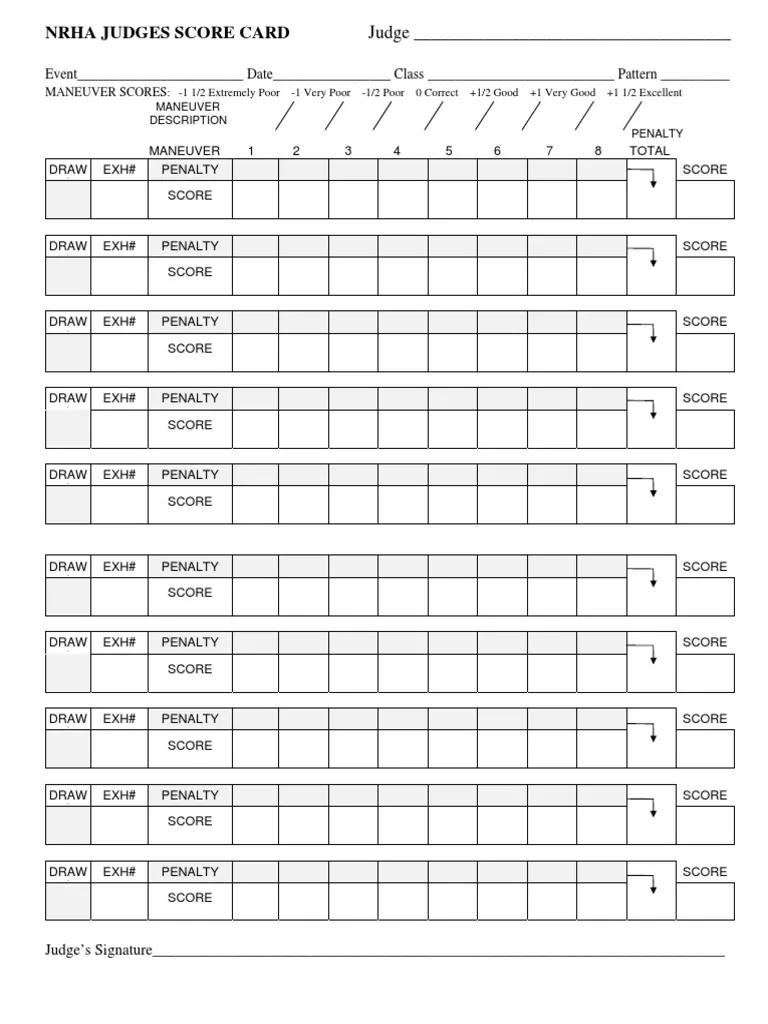
Score Sheet
The official NRHA score sheet, originally developed in 1985 with the new judging system, is filled in by a scribe who sits next to the judge. The sheet features the draw number and exhibitor number so that the show office records the correct score for each exhibitor, and then space for a maneuver score and any penalties. The judge will call a maneuver score and penalties to their scribe and the scribe will add up the scores and penalties at the end of each run for an official score. In the case where 5 judges are judging the highest and lowest score are dropped.
Maneuver Scores
A judge will give each maneuver a score based on correctness, willingness, controlled speed and difficulty level. Maneuver scores are in half point increments ranging from -1 1/2 to +1 1/2, with a 0 being given for a correct maneuver with no degree of difficulty.
+1 1/2
Excellent
+1
Very Good
+1/2
Good
0
Correct
-1/2
Poor
-1
Very Poor
-1 1/2
Extremely Poor
Penalties
Sometimes things go wrong during a run and these result in a penalty. Break of gaits, over or under turns, and more will result in a penalty. One trip in the show pen can even result in multiple penalties
Lead changes 1 stride too early or too late
a 2 stride area is given for a horse to perform its lead change inside the middle of the arena during the pattern. In major events a laser of this “box” is actually projected onto the arena for judges and the audience to see before the start of each section of runs. If a horse changes 1 stride before or after this “box” then a 1/2 point penalty is given
Jogging up to 2 strides, or 4 steps, out of a rollback or into the lope
a judge will count the steps with the back feet to determine how many steps have been taken
Over or under spinning more than a shoulder width but less than 1/8 of a spin
Riding closer than 20ft to the wall during or after a rundown
Riding within 10ft of the center of the arena during or after a rundown
Out of lead in a circle
for each 1/4 of a circle that a horse is out of lead a 1 point penalty will be given
please note: there is no correct lead for a run down. So long as a horse is in the correct lead going around the ends there is no penalty for lead changes during the run down or coming out of a roll back
Out of lead before or after a run down around the ends of the arena
if a horse is in the wrong lead from the turn to the halfway point coming around the arena for a run down a 1 point penalty will be given
Over or under spinning 1/8 to 1/4 of a spin
A simple lead change that takes place within the “safe zone”, but outside of the “center”
a simple lead change that takes place in the space that is 1/4 of a circle before or after the center of the arena where the simple change should take place, but is outside of the 3 stride area given for the simple lead change in the center of the arena, will incur a 1 point lead penalty
Break of gait
please note: if a horse briefly slips during a downward transition from a large fast circle to a small slow circle without breaking cadence, this should not receive a break of gate penalty. However, if a horse clearly slides then it should receive a break of gait penalty, and if it stops then it should receive a zero score.
A break of gait penalty can be incredibly brief so judges train to be able to catch even the smallest breaks of gait.
Also note: simple lead changes are allowed in the green Reiner class and some modified patterns in the ride and slide class, and are not considered a break of gait.
Freeze up in the spin or roll back
defined as a brief but obvious refusal to start a spin or roll back, or a brief stoppage during a spin or roll back
example: a rider completes 3 spins, pauses, and then completes the fourth
Failure to walk or stop before the start of the pattern
Failure to run past the required marker before stopping
if a horse begins stopping before the correct marker during a pattern they will receive a 2 point marker penalty regardless of where the stop ends. Markers are required to be set so that a horse has enough room to stop after the marker.
Failure to be in the correct lead beyond the halfway point up to the beginning of the run down
remember a horse may be on any lead for the run down, but around the ends of the arena must be on the correct lead.
Jogging more than 2 strides, or 5 steps, out of a rollback back or into the lope
A judge will count the steps the horse takes with its back legs to determine how many steps or strides the horse takes
Spurring in front of the cinch
Use of hand to instill fear or praise
Note: for riders to avoid accidentally receiving this penalty riders must pause to signal the end of the pattern before giving their horse a pat at the end of a run. Please note that when stopped during the pattern a rider is allowed to untangle the reins, but must not touch the reins in front of the hand.
Holding the saddle with either hand
the exception to this are freestyle, green Reiner, short stirrup, or non pro riders 65 and older
Blatant Disobedience
this is defined as the horse kicking out, rearing, bucking, biting, striking, or other such actions
A horse dropping to its knees or hocks
in the event the horse’s knees or hocks touch the ground it is not considered a fall, only a 5 point penalty. The point at which the shoulder, hip, and/or underline touch the ground is when the penalty becomes a zero score.
Please note: a horse who is a deep stopper whose hocks touch the ground during the stop does not receive a 5 point penalty.
Improper use of romal reins
Failure to complete pattern as written
this can include doing circles in the wrong order, crossing the centerline after a rollback, or over turning more than 1/4 of a spin, or stopping during the pattern where a stop is not called for
please note: if a horse stops in the first 1/4 of its circle to correct a lead that is considered a break of gate and not a zero score
A horse or rider who has fallen
A fall is considered a zero score if a horse touches the ground with its shoulder, hip, and/or underline, or if the rider falls from the horse and touches the ground.
Backing more than 5 steps, or 2 full strides, outside of the back up written into a pattern
Refusal or balking by the horse
it is up to the judge to distinguish between a freeze up and a refusal or balking, but a horse who refuses its riders commands receives a score of zero.
Trotting more than half of a circle or half the length of the arena
this penalty does not apply to the trot in portion of a pattern
Rider holding the reins with 2 hands
this penalty does not apply to riders showing in a snaffle bit where allowed, or to a rider holding the tails of the romal reins, or to a rider showing in a bosal where allowed
A No Score penalty is considered extremely serious. Any judge issuing a no score penalty must report it to the show steward and/or show representative with instructions to include the details of the no score in the official show representative report. The judge must also present a report of the no score to an official. Riders receiving 3 no scores in a year will automatically be suspended for 6 months.
Failure to present horse for pre or post run inspection if required.
This includes not dismounting or dropping the bridle for the inspecting judge.
A lame horse.
While judges are not vets, a horse that is consistently observed to be a lame grade 3 or above (head bobbing or lack of weight bearing) will be dismissed by the judge and given a no score
Blood on the horse
A horse with clear evidence of blood on the mouth, nose, chin, shoulder, barrel, flank, or hip is considered to have an injury caused by the rider or equipment and will receive a no score.
Illegal Equipment
Here is a great guide to legal and illegal equipment. Please note that this only applies to horses being shown. Equipment is not monitored outside of the show pen, so a horse can warm up in an illegal bit for example and then switch to a legal bit before showing. Pre check judges may also give an exhibitor the opportunity to fix illegal equipment to prevent a no score
Abuse
If a judge feels that a horse is being abused by the rider (defined as a horse that is unfit to show, or if the judge determines that showing the horse would be cruel, abusive, and inhumane) or if the judge observes the rider acting in a manner towards the horse that would be considered cruel or inhumane the judge may dismiss the rider at any time during the pattern for unsafe conditions or inhumane treatment of the horse.
Failure to dress appropriately
No Scores will be given for failure to dress appropriately. Even if your intention is to school a class, you MUST dress yourself AND YOUR HORSE appropriately:
-Long sleeves with collars, buttons, snaps or zipper.
-Long sleeves must be rolled down.
-NO sweatshirts/hoodies.
-Vests/Jackets may be worn over an appropriate shirt.
-Must wear a Western hat or safety helmet, boots, western saddle, and western bridle.
-Chaps are recommended for classes that have $2,000 or more added money.
-Illegal to show with a braided tail
-Illegal to show with a tail bag
-Illegal to show with a belly band
Reviewed Scores
Sometimes a judge needs to review the score they’ve given a rider. Here are the conditions that must be met for a score to be reviewed. In the event of a reviewed score, the score will be announced as under review and is often reviewed during the next drag break and then the score is announced after the drag once it has been reviewed.
Held Score
If a judge is unsure about a penalty they can submit the score but request it to be held pending a review. The score will then be announced as a held score and reviewed from the official video during the next drag break, or when the judge is able to.
Reviewable Penalties
Only no score, 0 score, 5 point, and some 2 point penalties (break of gait, jogging more than 2 strides, and freeze ups) may be reviewed.
No Conferring
a judge may not confer with other judges about penalties or maneuver score prior to submitting a score, but they will conference about a penalty during a review and a judge will have the option to change the penalty and/or maneuver score for the maneuver that is under review only, but they are not required to.
Review
After reviewing the official video judges may discuss the maneuver and penalty (or lack there of) and judges will have the option to change their score score or leave it. Following the review the official score will be posted and/or announced.
Did You Know?
Judges must continue to judge and score zero and no scores in a videoed or multi judged event in case they decide during the review that they would like to change their penalty and/or maneuver score for that maneuver.

Stumbles
While not a penalty, judges are instructed to deduct a 1/2 point from a maneuver where a horse stumbles enough to affect the maneuver.
Tails
While not a specific rule, judges are instructed to deduct a 1/2 point from circles where a horse’s tail looks dead and is flopping or unmoving, indicating that the tail may be nerve blocked or the nerves have been cut. While NRHA has not come out with an official stance on this, this is their way of ridding this practice from the industry, however it is up to each individual judge.
Similarly a horse who is wringing its tail or pinning its ears and appears uncomfortable or irritated may have the maneuver deducted.
A horse who simply carries its tail closer or further away from its body should not receive any maneuver deductions.
First impressions
Remember from the time a judge can see you they are judging you. If you are standing at the entrance to the arena yanking on your horse’s face, excessively spurring them, taking too long to enter the arena, or pulling on your horse’s face the whole way to the center of the arena that is going to give a bad impression to your judge which will affect your score.
The judge is also evaluating your horse’s soundness and a lame horse will be dismissed with a no score.
NRHA Judging
What else can affect your score?
While not penalties, these things can also affect the score a judge gives you.
NRHA Judging
Did you know?
Not displaying your exhibitor number is a $25 fine
An exhibitor who does not display their correct exhibitor number when showing will receive a $25 fine and the Show Representative and /or Steward will make a note in their Show Report.
NRHA grants special permissions for challenged riders
NRHA is a big supporter of challenged riders, and riders needing an accommodation can submit this to NRHA and receive special permissions for any needed aids while showing. Riders must present the letter detailing this from NRHA to each horse show so that the show can pass it along to the judge along with the exhibitor’s number. This way no challenged rider is restricted from showing in the sport that they love!
Rules and penalties are evaluated annually
Each year the NRHA Board and the NRHA Judges Committee review all of the rules for judging to determine if any changes need to be made
You can contest a judge
There are 3 ways to can contest a judges decision:
Equipment Judge
If you feel an equipment judge has made an incorrect call in giving you a no score you, your trainer, representative , or parent/guardian may contest the judge’s decision. This will then mean that the equipment judge must detain the horse and equipment until the other judges may inspect it and make a final call on the no score
Incorrect Score
Don’t agree with a no score, 0 score, 5 point, or 2 point penalty you received? You have up to 30 minutes after the last class of the day, and before the judge(s)has left the show grounds, to request a review of your score by the judge, but only if their is an official video of the entire class. The judge has the right to deny or honor the request, and may watch the official show video to determine if the penalty was correctly given. The request must be made to the Show Steward, Show Representative, or Show Management who will take the request to the judge(s).
The JEEP system
Do you believe that a judge is judging a run incorrectly or behaving badly while judging? You can at any time submit a JEEP to the Judge’s Committee.
JEEP form
A JEEP (Judges Evaluation and Education Program) is a non-punitive system developed by the NRHA Judge’s Committee in the 1990’s to review the performance, protocol, and conduct of judges and aims to educate and improve show judges.
Anyone can JEEP a judge, including other judges who feel a judge needs more education, which is the ultimate goal of the JEEP.
The Judge’s Committee reviews all JEEP requests and watches the official video from the run and makes a call on if a judge needs more education. This can mean anything from a phone call to a judge, to a judge being required to attend an additional judges school, to even a judge losing their judging privileges in extreme cases.
Any chair judge may stop a run
Any horse at any time during a run may be stopped by a chair judge in the event of abuse or unsafe conditions. If the rider contests this then all judges are called in as soon as is practical to confer.
Note: while a judge is not a vet they are trained to recognize a horse who is lame grade 3 or above (obvious head bob or worse) and will stop a run and dismiss the horse and rider, giving the run a no score.
Read the Rulebook
want to read it straight from the pages? Read the NRHA rulebook here:
NRHA Judges
NRHA Judges Program trains and certifies all NRHA judges. All judges must be at least 21 years old and must retest every 2 years to maintain their judges card. The Judges Advisory Committee sets the standards for judging and oversees all NRHA judges.
Learn MoreMark How, NRHA judge since
HorseIQ
Want to learn more about judging the same way the NRHA judges do? Sign up for horseIQ! This website offers videos, training, and practices so you can learn everything about judging reining. Some resources are free, others you will need to purchase a subscription but the reining materials here were all developed by the Judges Committee.